Sometimes you can't work something out directly ... but you can see what it should be as you get closer and closer! We call that the limit of a function.
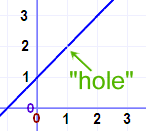 | For example, what is the value of (x2-1)/(x-1) when x=1? (Notice in the graph there is actually a "hole" at that point). Let us substitute "1" for "x" and see the result: (12-1)/(1-1) = (1-1)/(1-1) = 0/0 |
But 0/0 is "indeterminate", meaning we can't determine its value, so instead of trying to work it out for x=1 let's try approaching it closer and closer:
| x | (x2-1)/(x-1) |
|---|---|
| 0.5 | 1.50000 |
| 0.9 | 1.90000 |
| 0.99 | 1.99000 |
| 0.999 | 1.99900 |
| 0.9999 | 1.99990 |
| 0.99999 | 1.99999 |
| ... | ... |
Now we can see that as x gets close to 1, then (x2-1)/(x-1) gets close to 2, so we say:
The limit of (x2-1)/(x-1) as x approaches 1 is 2
And it is written in symbols as:
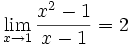
We don't know the value at x=1 (it is indeterminate), but the limit has a value of 2
More Formal
But you can't just say a limit equals some value because it looked like it was going to. We need a more formal definition.
So let's start with the general idea
From English to Mathematics
Let's say it in English first:
"f(x) gets close to some limit as x gets close to some value"
If we call the Limit "L", and the value that x gets close to "a" we can say
"f(x) gets close to L as x gets close to a"

Calculating "Close"
Now, what is a mathematical way of saying "close" ... could we subtract one value from the other?
Example 1: 4.01 - 4 = 0.01 
Example 2: 3.8 - 4 = -0.2 
Hmmm ... negatively close? That doesn't work ... we really need to say "I don't care about positive or negative, I just want to know how far" The solution is to use the absolute value.
"How Close" = |a-b|
Example 1: |4.01-4| = 0.01
Example 2: |3.8-4| = 0.2
And if |a-b| is small we know we are close, so we write:
"|f(x)-L| is small when |x-a| is small"
| And this animation shows you what happens with the function f(x) = (x2 - 1) / (x-1)
So
|

Delta and Epsilon
But "small" is still English and not "Mathematical-ish".
Let's choose two values to be smaller than:
 | that |x-a| must be smaller than |
 | that |f(x)-L| must be smaller than |
And we have:
"|f(x)-L|< |
That actually says it! So if you understand that you understand limits ...
... but to be absolutely precise we need to add these conditions:
| 1) | 2) | 3) |
| it is true for any >0 | exists, and is >0 | x not equal to a means0<|x-a| |
And this is what we get:
"for any |
That is the formal definition. It actually looks pretty scary, doesn't it!
But in essence it still says something simple: when x gets close to a then f(x) gets close to L.
How to Use it in a Proof
To use this definition in a proof, we want to go
| From: | To: | |
| 0<|x-a|< |  | |f(x)-L|< |
This usually means finding a formula for (in terms of ) that works.
How do we find such a formula?
Guess and Test!
That's right, you can:
- Play around till you find a formula that might work
- Test to see if that formula works.
Example: Let's try to show that

Using the letters we talked about above:
- The value that x approaches, "a", is 3
- The Limit "L" is 10
So we want to know:
| How do we go from: | 0<|x-3|< | to | |(2x+4)-10|< |  |
Step 1: Play around till you find a formula that might work
| Start with: | |(2x+4)-10|< |
| Simplify: | |2x-6|< |
| Move 2 outside: | 2|x-3|< |
| Move 2 across: | |x-3|</2 |
So we can now guess that =/2 might work
Step 2: Test to see if that formula works.
So, can we get from 0<|x-3|< to |(2x+4)-10|< ... ?
Let's see ...
| Start with: | 0<|x-3|< |
| Replace: | 0<|x-3|</2 |
| Move 2 across: | 0<2|x-3|< |
| Move 2 inside: | 0<|2x-6|< |
| Replace "-6" with "+4-10" | 0<|(2x+4)-10|< |
Yes! We can go from 0<|x-3|< to |(2x+4)-10|<by choosing =/2
DONE!
We have seen then that if we choose a we can find a , so it is true that:
"for any, there is a so that |f(x)-L|<when 0<|x-a|<"
And we have proved that

Thank you for this great Post Sharon. It is clear that you spent a lot of time on it, good work!
ReplyDelete